How to share a lookout
Visit outdoors in comfort!
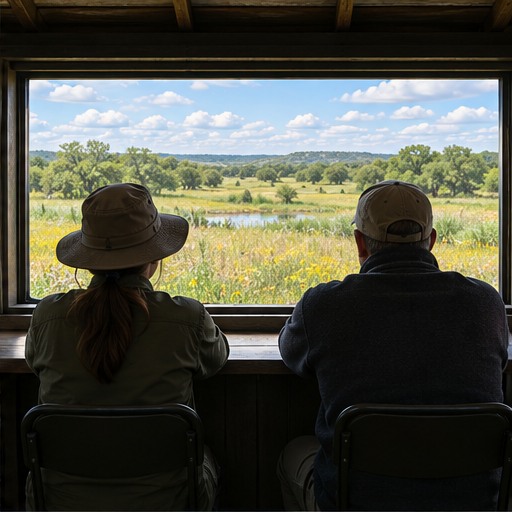
Even a simple viewing post for wildlife watching can turn into a very embarrassing matter for everybody if their gear ends up to be in the way of viewing wildlife. Making a few simple decisions before other people arrive at your outdoor viewing post will result in them having a much more comfortable, safer, wildlife viewing experience. And that will be true whether they are new to wildlife viewing or have many years of experience.
Make room before the first scan
This doorway is for your bags. Pack soft ones and place them under the benches. Do not block boot space with bags. Do not hang your jackets from the doors to the blind. These could get in the way of people entering and leaving the blind. Essential items such as water, phones and first aid kits can be left at the viewing post.
Remember a tall tripod is best sited at the edge of a viewing area as it can extend a long way and spread its legs more than a short monopod or a pair of handheld binoculars. Make sure all the legs of your tripod are planted firmly on the ground before you go to have a look through the eyepiece. A loose tripod is far worse than having no view of wildlife at all as you will be so concerned with stopping it collapsing.
Even when a hunting blind is being used for wildlife observation, it is crucial to realize that there will not be as much room in the 'corner' of the blind for extra gear and other objects as one would expect. This means that space must be left for people to stand up and turn around in order to leave the blind. This could be in the event of bad weather, someone becoming ill, etc. And it could become a very uncomfortable situation for everyone.
Set up different viewing jobs side by side
Set up different viewing jobs side by side. Remember that for most people wildlife watching is a series of different things to look at over time. So plan for the longer items of equipment to go in the best place for viewing what you are about to search for, and then let the others with shorter handheld items sit and view more open areas. Others can write in notebooks or take photographs with their phones. Try to keep these items below eye level.
The less mobile viewing spot in your Viewing Post should be taken by the more experienced person. The beginner will have plenty of room to turn and look in different directions. Later on you can swap places.
It is not too hard to figure out when things are beginning to get a little cramped. There are a number of very obvious signs. Check every now and then to see if people are stooping to peer over straps of their equipment. If they are to be constantly leaning round to view from alternative perspectives then it is probably time to re-arrange things. Also check to see if any of the legs of a tall tripod have been placed near doors etc.
Give directions that can actually be followed
Say where you found it. Provide directions to the location of wildlife that you have discovered while viewing. For example tell people that the bald eagles that you saw yesterday were located at a completely different place. Instead of telling everyone that you saw two bald eagles sitting on a 30 foot tall dead tree in the SW corner of the state park tell them that you saw two bald eagles perched on a 30 foot tall dead tree in the SW corner of the state park.
Be sure to give the person enough time to find the animal you found. Don't give them a list of directions to the animal. Start with one direction and then add more to that direction. For example, you might say, "Look just left of the fallen branch. Keep the branch at the bottom of your view and then raise up in your gaze."
Don't reflect light off wildlife by using your fingers to point out the animals by pressing against the glass. Instead refer to the frame of the blind or outside of the blind and then move your head to view the animals or block light by placing a dark colored sleeve against the glass.
Just because you failed to see the animal does not mean you failed at wildlife watching. Work with the other person to reframe your view of the animal.
Swap seats during a natural break
It can take some time for wildlife to appear and lots of time can pass where nothing seems to be happening. It's a good opportunity to swap seats so everyone can have another look at wildlife. Let people know you are moving their chair or tripod and make sure they are okay to stand up and move to another seat. Also, make sure they check the floor, doorway and any equipment that may have been moved.
Where someone has set up a long item such as a spotter scope to view wildlife (e.g. across a prairie from inside a blind) it is best to leave it as they have it and for viewers to swap seats and 'hand over' viewing and noting of wildlife with each other using such items as binoculars, camera etc. All is required is for the more experienced person to explain the setup of the viewing and noting equipment that they have used before handing over to less experienced people. It is best to allow a few minutes to pass before returning to 'main' seats for viewing wildlife.
This takes a few moments for a new person to become oriented to the setup and to have a look. But in the end, a short description of what they are looking at is far better than removing them from their very comfortable viewing spot. The swap of viewing equipment can be done with people remaining in their very comfortable seats and swapping viewing scopes, etc.
Keep sensitive details out of the crowd
Information shared through public posts must be kept very general regarding the location of the view or the species involved, in particular sensitive species that could be easily disturbed by humans. A posting of bald eagles at a different location yesterday would be more desirable than a posting of the 2 bald eagles found yesterday in the SW corner of the state of such-and-such, perched on the 30 foot tall dead tree in the center of the viewing area.
Randall White
While some information may be looked over by experienced wildlife observers, the same information can draw in many people to an area and be detrimental to a quality wildlife viewing area. It is okay to share this information with other members of your group while you are viewing wildlife together in a public setting; however, use caution when discussing the location and way to view wildlife within a public setting.
It is all about managing access to wildlife viewing, attention to other people and information about wildlife in the area. It means to keep a door to the blind open, place a tall tripod at the end of a viewing area, use fixed objects as references when describing the animals viewed and switch places from time to time in order to give others a change to view comfortably.
Keep reading
All stories
The quiet hour
These hours before dawn, difficult as they are to arrange, are in themselves the best part of any…
Read more
A field notebook on one page
A Simple Structure - Space for Sketches & Questions and for recording the Weather.
Read more