Wind notes from the prairie
Read wind in grass & write more useful notes about day.
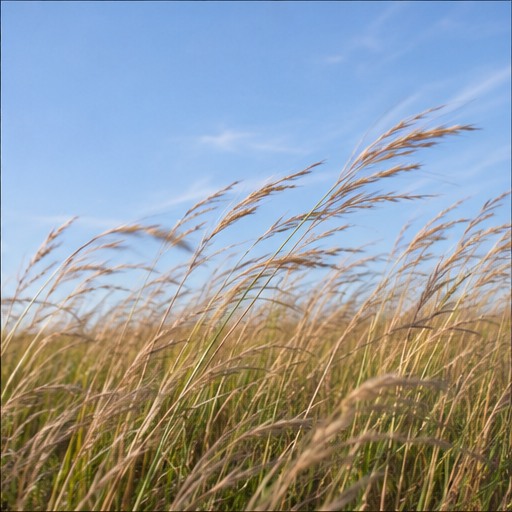
A familiar field can become a totally different place in the space of a few hours with wind influencing how clearly you can hear certain creatures, making exposed paths less comfortable to walk along and wildlife notes less useful later on. Thus, it is useful to read the wind in the grass before setting off and take note of whether it is staying in one place and whether it is being blocked by a bank or whether it is changing with the sun.
Start with three levels of movement
Stand at the edge of a field for thirty seconds and observe the tall grass, a nearby shrub and a tree in the distance. Each of these will give a different reading of the wind because of their height and the amount of shelter they offer and the channeling of the ground around them.
A tall patch of grass may give the best indication of low level wind. Look at the way the blades of grass are leaning, whether they are immediately springing back up, or whether they are moving in short, sharp, waves. A nearby shrub may also be persistently pushed by the wind, particularly through the outer leaves.
Each single tree can be in a different situation than you think at first glance. It can be in a gap, at the end of a slope, at the edge of a wind channel or even stand in a depression. So take a good look at more than one tree before deciding on a direction.
Comments for wind include whether the grass is predominantly leaning to one side, whether the outer leaves of shrubs are turning in short bursts and the upper branches of trees moving steadily. A simple note would read: 'Grass mostly leaning east, shrub leaves turning in short bursts, upper branches moving steadily'.
Describe what the air does at your height
The wind at head height is only part of the picture for the effect of the air upon the observer. A low bank or even a fence, a turn in a path or a group of brush can make a spot that feels calm for a man with a scope to set down his book and leave again, be quite exposed for someone to sit and read from.
When using your body to test for wind make sure you test for wind in more than one way. This includes feeling the air against the side of your face, on the back of your neck, in your hair and in your hands. Pay attention to whether the wind feels consistent or whether it comes in uneven gusts. Watch a hat brim, loose paper, your strap etc. – all of these will tell you of air movement that you may have otherwise missed.
You can make different judgements as to where wind is coming from. A sheltered area can seem to have wind coming from a completely different direction than an open area. If you find that the wind changes as you walk down a track then record this. However if the wind disappears as you go round a bend in the track or over a low bank then it is the other feature which is providing the shelter, not blocking the wind.
Make the notebook useful tomorrow
You may want to note how fast you feel it to move to make a more informed decision tomorrow but in the end just note what you feel and saw at the place and time you wrote your field notes. This could be something as simple as "cool from the water, stronger gusts of wind when the sun comes out". Include the time that you wrote this note as well as the direction that seemed to be the most consistent and whether it seemed to be moving steadily, in waves, or erratically scatteringly.
Even a brief description of a location does well to note whether one can sit comfortably there with a scope, or if the note-scraps and other items will be in danger of being blown away. Then in due course on return to camp one can simply dispose of the scapped notes without spreading them about or tying them to grasses and stalks etc.
Ambiguity should be noted as ambiguous in the field notes. So, "I think it's going west to east" should be written down as "Likely west-to-east". A small compass can be used to check the apparent movement against the actual direction of the compass, but a compass is only any good for giving a general direction and does not account for local features redirecting air.
Even slight changes to patterns observed need to be recorded. If previously the grass had been moving in low, even waves then suddenly it starts to move in short, irregular pulses then this is worth noting. Similarly, if previously loose dust and leaves had been blowing across the trail in one direction, then suddenly they start to cross the trail in the opposite direction then this also is worth noting.
Test two places before settling in
When choosing a seat look for two or so locations a few yards apart and then feel for difference in sound of grass, pressure on clothes etc. of loose items. A low bank, or turn in a path can create a sheltered spot but check that it doesn't also block view and create a problem for leaving.
The observer compares two positions, about a few yards apart: one with a clear view, but with the wind blowing across his notebook, the other behind a low rise, keeping his papers flat but offering a safe route back to the path. This would be a sensible choice, and the observer records the fact, but not with the implication that all animals would make a similar choice.
Make sure all loose items are tied down including your backpack straps and any items you have in your pockets. Try to shorten up your scope or get into a more stable position if it were to blow over. It's worth making a bit of a detour to get to a position of safety rather than risking damage to your gear.
Let weather awareness set the limit
And check for before you leave the field in similar manner to how you would check your camp before leaving. Check all shelter lines, loose stakes, any closed but loose packing, and other light weight objects that could blow away in strong wind. A flapping tarp edge, a rattling buckle, or repeated movement of a stake are all symptoms that you need to fix up before leaving the field.
Monitor worsening visibility, detritus blown around, weak-flailed branches, etc. Should keep such observation short, travel along previously shielded routes or even retrace original path. Weather-awareness is merely routine.
Remember to leave everything as you found it, pack up all your note scraps and don't tie anything to any plants and trees. The ideal entry will list the wind, the restrictions it imposes and the ways you adapted to it to complete a pleasant and safe outing.
Keep reading
All stories
After the first rain
Take a short walk around to find out what recent storms have done to the area that you…
Read more