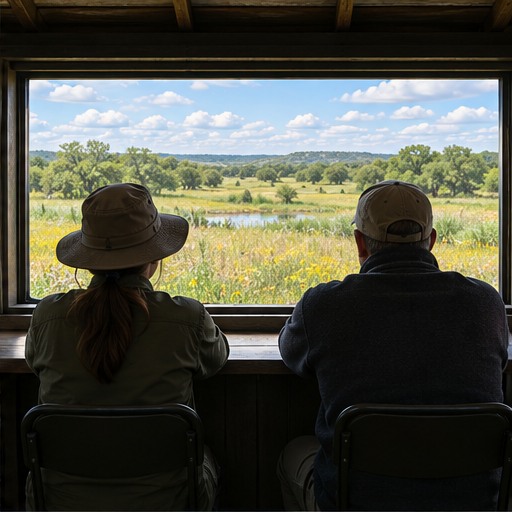
A field notebook on one page
A Simple Structure - Space for Sketches & Questions and for recording the Weather.
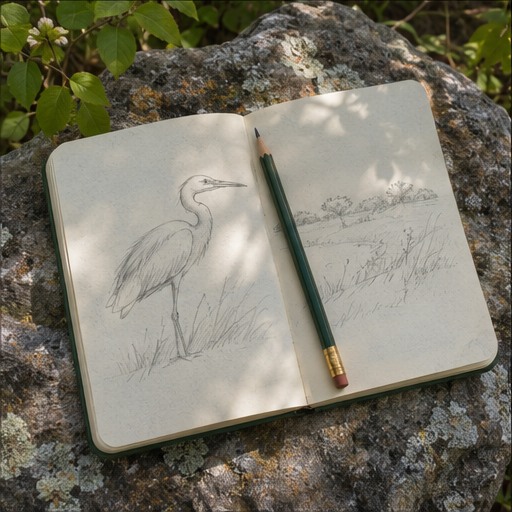
A simple page of notes that attempt to follow a traveling stop does not have to include every bird you saw, nor attempts to explain their behavior. What is important is to record as best as you can what you observed to happen, when it happened, and what you left unanswered. A simple two-column page will do for notes to record your traveling stop observations, questions that need to be answered on subsequent visits. Such a simple page also provides space for later studying of your notes and can even serve as a guide for future visits when you go for a short jaunt to the same stop with a guide book, sketches, etc.
Put the conditions at the top
The top line on the first page of the stop's notes would read: late spring, grassland trail near a stock fence – warm, breezy, high clouds. Late spring, would signify a period of time and allow the observer to fill in the rest of the page later. The location would remain general enough so that a reader would have no idea where the observer had stopped to write these notes in the wildlife of private property. The rest of the line would fill out the weather, i.e., warm, breezy, high clouds.
Time also should be recorded. If possible, this should be at the top of the first line of observations. However, if you do not know the time of your first observation then this should be noted at the end of the page under 'things to do next time'.
Note weather conditions (rain, heat, cold, etc. including any instance of lightning) – write out as fully as you can. As for forecasting, it's quite simple: don't do it. If you are out writing notes when it becomes uncomfortable or starts to become dangerous (even in the case of small rain), pack up and leave. A notebook is not worth your safety.
Separate what happened from what you think
Draw a line down the page or make two clearly labeled sections for the following: Observations | Questions. The Observations section should contain only what you can verify to have actually happened using your senses and a clock.
This simple observation may be recorded as follows: 8:14 a.m. A small bird is on the top wire. It is a bird with a brownish back in the shadow. It goes to the end of the fence post and then disappears into the grass. A pale flash of something appeared at the edge of its tail as it moved.
The description of the bird might not read too well as a species description but it is very useful when uncertain about an ID as it details all the observations made about the bird's form, color etc. and these can be compared against other birds seen to try and arrive at a correct ID. 'Small bird' is fine as it leaves all the possibilities open. A description of a 'Pale flash' of color on the bird's tail, for example, could be very useful later on.
Record what you did not observe and how you were affected by it. This is how you note that you did not observe any parts of the animal that were hidden by grass or that the animal's feet were not visible because of the ground, or that you did not hear any of the animal's calls because of the wind or because of traffic noise in the distance.
Give questions their own working space
The reverse side of a page of notes will contain your questions, problems or things you wish to investigate further on a return visit. These may be: "Was the pale mark on the tail of the bird above of a gap between two of its feathers?" "Did it leave because of my approach, the wind or another animal?" "Would the same fence post be of value to investigate at a different time of day?"
It's good to indicate when you were uncertain with a question mark at the end of a guess. This way you can go back later and cross off the wrong ID and then include the later more accurate ID with a note on how you arrived at that ID. That way your best guesses are recorded too.
Use your notes to work out how to set up your next stop to best answer your questions. Your questions will often lead to simple but very useful notes like: "I'll bring a hat with a brim" or "I'll go back on a calm day". These notes are all about preparation. They don't guarantee that you will see any wildlife but they will mean that you are better prepared to make the most of your time.
Use a small sketch as a record
It does not have to be a masterpiece! Sometimes just drawing a few lines to indicate the angle of a branch or the bird's body can help you remember important details about what you saw. Mark an arrow on the sketch and write what that arrow means. A month from now a similar mark could indicate a leg, a twig or even a shadow.
Sketch a simple drawing of fence post and wire(s), place an arrow indicating the bird's direction of travel. Note body and tail position (e.g. "tail down angled", "body turned left"). A simple single oval for the body with a single line down back and an arrow for movement would be a good 'portfolio' sketch to represent this observation in a short amount of time (less than 2 minutes).
The simple format of the nature journal is best served by keeping the journal itself simple to use in the outdoors. This means using a small notebook, opened to the correct page, and written in with a pencil. Your binoculars should be carried in such a way as to allow for one hand to be used for support of the journal and pencil as needed. Remember to keep your back to the direction of travel and watch where you step on uneven prairie paths and areas of ground that may hide holes, loose rock or low wire.
End with one next-visit decision
A one or two sentence summary of what you plan to do differently for your next stop. "Next time I will stand further from the fence and watch the post for 5 minutes" or "Next time I will note the wind direction before listening for birds to see if they have a different song".
A thoughtful final note for a set of field notes turns journaling nature in the field into a repeatable activity. Nature journaling does not have to include getting close to wildlife and attempting to take photos. It can include simply being outside at nature and recording what you saw there. As long as you are outside of private property, on a permitted route through the natural environment, and not blocking a trail or cornering any wildlife, you can return to the same stop in later months or years to continue writing field notes there.
Keep reading
All stories
The quiet hour
These hours before dawn, difficult as they are to arrange, are in themselves the best part of any…
Read more